DiseaseBD |Bangladesh’s Trusted Online Medicine Index & Comprehensive Healthcare Portal

Disease
Generic selectors
Exact matches only
Search in title
Search in content
Post Type Selectors

Arain is used for— Providing effective relief from migraine headache pain, helping to reduce the severity and discomfort associated with migraines. Serving as an analgesic to manage post-operative pain and to help reduce fever, supporting overall patient comfort during recovery.

Mechanism of Action:

Tolfenamic acid (N-(2-methyl-3-chlorophenyl) anthranilic acid) is a member of the fenamate group and acts as a potent inhibitor of the cyclooxygenase (COX) enzyme. By inhibiting COX, it reduces the synthesis of key inflammatory mediators such as thromboxane (TX) B₂ and prostaglandin (PG) E₂, which are responsible for pain, swelling, and inflammation. In addition to inhibiting prostaglandin synthesis, tolfenamic acid also exhibits a direct antagonistic effect on prostaglandin receptors, enhancing its anti-inflammatory and analgesic actions.

Pharmacokinetic Properties:

1. Absorption: Readily absorbed from the gastrointestinal tract; peak plasma concentration occurs within 60–90 minutes.
2. Bioavailability: Approximately 85%.
3. Distribution: Highly protein-bound (99%).
4. Plasma Half-Life: Around 2 hours.
5. Metabolism: Metabolized primarily in the liver; undergoes enterohepatic circulation.
6. Excretion: Eliminated mainly via urine (≈90%) and to a lesser extent in feces.

Adults:

1.Acute migraine attacks: Take 200 mg at the onset of symptoms; may repeat once after 1–2 hours if needed. 2.Mild to moderate pain: 100–200 mg, three times daily (TID). 3.Renal impairment: Dose adjustments may be required. 4.Severe renal impairment: Use is not recommended.

Children:

A pediatric dosage schedule has not been established.

Administration Instructions:

1 Tolfenamic acid should be taken with food.
2. Take with water during or immediately after meals.

The absorption of Tolfenamic Acid is increased when taken with Metoclopramide or Magnesium hydroxide, but is reduced when administered with Aluminium hydroxide. Concurrent use with anticoagulants or other NSAIDs may elevate the risk of bleeding. Tolfenamic Acid can also diminish the antihypertensive effects of loop diuretics, beta-blockers, and ACE inhibitors. Additionally, co-administration may raise plasma concentrations of Lithium, Methotrexate, and cardiac glycosides. The risk of nephrotoxicity is further increased when Tolfenamic Acid is used in combination with ACE inhibitors, Ciclosporin, Tacrolimus, or diuretics.

Tolfenamic Acid is contraindicated in patients with active gastrointestinal bleeding or ulceration, as well as in those with a history of gastrointestinal bleeding, hemorrhage, or perforation related to previous NSAID therapy. It should also be avoided in individuals with a history of recurrent gastrointestinal ulcers or in patients with severe heart failure

Tolfenamic Acid may cause side effects such as rare cases of alveolitis, hepatic damage, pancreatitis, pulmonary eosinophilia, Stevens-Johnson syndrome, angioedema, blood disorders, depression, diarrhea, dizziness, drowsiness, dysuria, euphoria, gastrointestinal bleeding and discomfort, hallucinations, insomnia, malaise, nausea, hearing disturbances, rash, visual disturbances, vertigo, and raised blood pressure. In cases of overdose, symptoms may include headache, nausea, vomiting, gastrointestinal bleeding, drowsiness, dizziness, and occasionally convulsions. Severe poisoning can lead to acute renal failure and liver damage.
This medicine is not recommended during pregnancy unless deemed essential by a doctor and should not be used during the third trimester. NSAIDs can pass into breast milk in very small amounts; therefore, their use should be avoided while breastfeeding if possible.

Caution is advised in patients with asthma, bronchospasm, bleeding disorders, cardiovascular disease, peptic ulcers, hypertension, liver infection, or impaired cardiac or renal function, as well as in elderly patients. Increasing water intake or reducing the dose may help minimize dysuria.

Store in a cool, dry place, away from light and out of reach of children.

Tolfenamic Acid is grouped with medications used for rheumatoid arthritis, non-steroidal anti-inflammatory drugs (NSAIDs), and other drugs indicated for the treatment of migraine.

Arain 200 mg Tablet Overview

Arain 200 mg Tablet works by strongly blocking the cyclooxygenase (COX) enzyme, which in turn reduces the production of key inflammatory substances like thromboxane (TX) B2 and prostaglandin (PG) E2.

Uses

This medication is commonly prescribed to relieve acute migraine attacks as well as mild to moderate pain.

Important Information:

1.Take Arain 200 mg Tablet with food or milk to minimize the risk of stomach upset.
2.Long-term use may lead to serious issues such as stomach bleeding or kidney damage.
3.It may increase the risk of blood clots, heart attack, or stroke.
4.Tell your doctor if you are pregnant, thinking of becoming pregnant, or currently breastfeeding.
5.Tell your doctor if you have kidney or liver problems.

Arain 200 mg tablet DiseaseBD

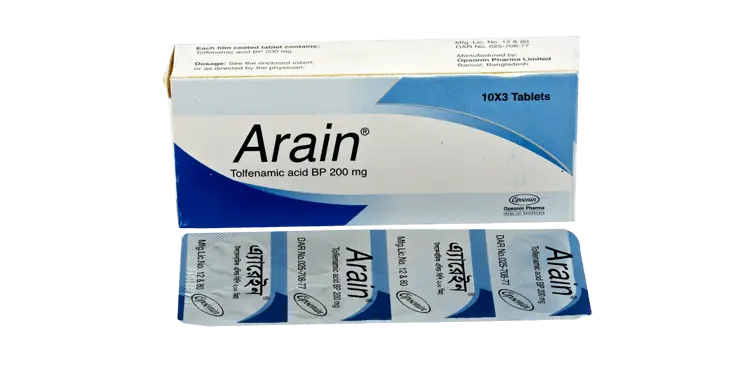
Pack Image: Arain

Arain

Scroll to Top